7 Habits To Help You Build Your Ideal Day
Workplace Health Expert Says Wellbeing is a Skill That Can Be Learnt
People
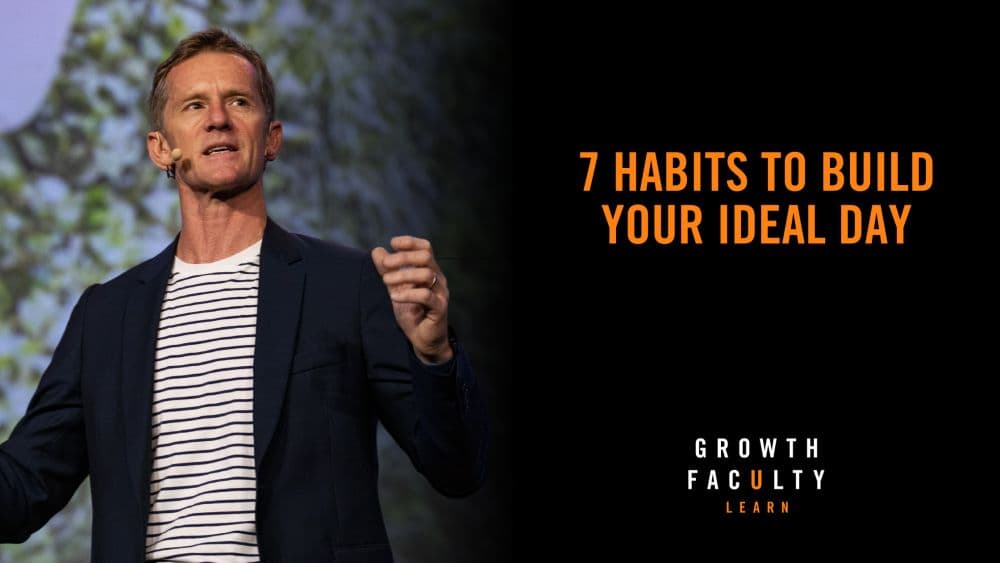
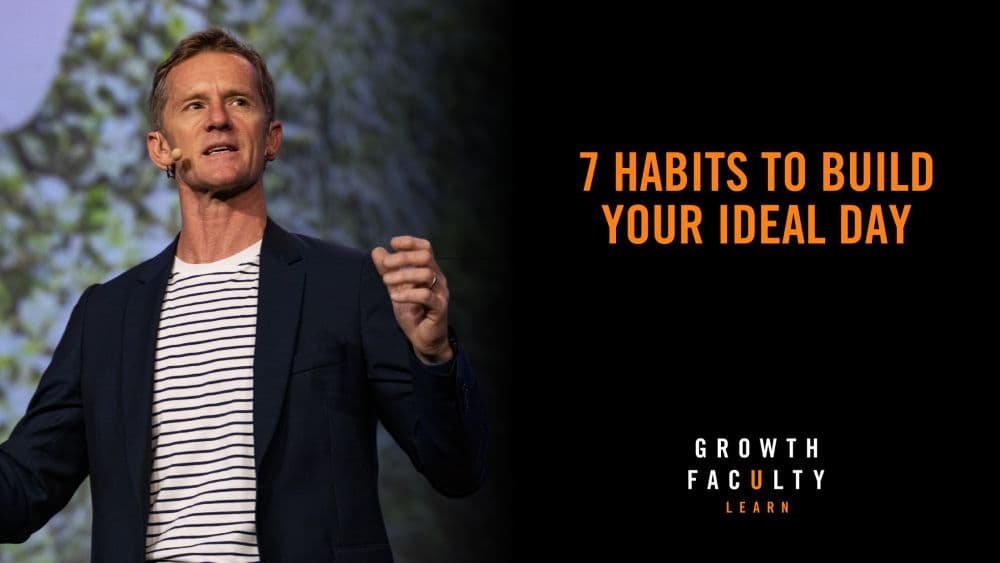
Duncan Young says wellbeing is a skill that can be learnt. The executive coach and former head of Workplace Health and Wellbeing at LendLease shared with our masterclass 7 Habits to Build Your Ideal Day some of the ways we can improve our energy levels and wellbeing to thrive more consistently at work and in life.
It starts with asking how we are right now.
Where Are You On Cantril’s Ladder?
To assess where you are right now, Duncan introduced us to the “overall life satisfaction” question called the Cantril ladder (after its innovator Dr. Hadley Cantril). Used in the Gallup World Poll, it asks respondents to think of a ladder, with the best possible life for them being a 10 and the worst possible life being a 0. They are then asked to rate their own current lives on that 0 to 10 scale. Action: How would you rate your life right now?
4-D Framework for Creating Change
Duncan shared the 4-D Framework for creating change:
1. Discovering what works well so you can feel authentically proud of the strengths you have to draw upon to make a difference for yourself and others.
2. Dreaming of what might be possible in the future by getting clear on your want-to goals (not have-to, should-do, or expected-of-you goals) for improving your wellbeing.
3. Designing pathways to move from where you are to where you want to be in ways that align with your strengths and your resources to leverage nudges, habits, and reflective practices to make your ideal wellbeing day a consistent reality.
4. Deploying small actions that can have a big impact and improve your levels of energy so you can continue improving your wellbeing.
Free Download: 10 Leadership Qualities That Will Help Solve Challenges in 2023
7 Habits to Build Your Ideal Day
There are 24 hours in every day, and each moment represents an opportunity to better yourself and your life. We need to get between 7 and 9 hours of sleep, we need to curate our gut biome with our food selections, and we need to get moving (the healthiest people in the world live in places that nudge them to move every day).
Apart from this, we should look at our lifestyle overall. Where can it be tweaked to make the biggest difference? Duncan says these 7 habits are a good starting point:
1.Using Your Strengths
Your strengths – the things you’re good at and enjoy doing – provide the best opportunities for creating changes that last because they boost your confidence, provide you with energy and leverage the ways your brain is always wired to work well. ACTION: Ask yourself:
-
What are your strengths, what are you good at?
-
What give you strength? What are you energised about, passionate about?
-
Ask others: Tell me about your success. Use every opportunity to boost others’ wellbeing.
2.Turning Up and Getting Started
Duncan says the biggest changes are see in people currently doing nothing who start doing something. As one of our favourite quotes from Atomic Habits author James Clear goes: “Every action is a vote for the person you want to become.”
Duncan says he also likes James Clear’s quote heard at Growth Faculty’s Atomic Habits event “Often the heaviest weight at the gym is the front door.”
In other words, just turning up and starting a better habit is a step in the right direction. ACTION: Where can you start doing something that will help to close the wellbeing gap?
3.Starting Small – Aggregation of Marginal Gains
As many of learned at the James Clear event, small improvements made daily compound over time.
In the beginning there is basically no difference between making a choice that is 1% better or 1% worse, Duncan reminds us.
But, as time goes on, these small improvements or declines compound, and you suddenly find a very big gap between people who make slightly better decisions daily and those who don’t. __ACTION: What daily habits do you currently have? Are they sending you on a positive trajectory, or a negative trajectory?
4.Shaping Your Environment
The art of making habits stick comes down to what we surround ourselves with. Our environment plays a crucial role in shaping our behaviour. As James Clear says in Atomic Habits, it’s a lot easier if you make your desired habits more obvious, attractive , and easily accessible while reducing the visibility of negative influences.
Duncan says one habit to build your ideal day is to optimise your environment to set yourself up for success and make it easier to follow through on your habits. Actions: Put a book (not your phone) on your bedside table, lay out exercise clothes next to your bed for the morning, stock your fridge with leafy greens etc. Also, pay attention to your digital environment. Make a breathing app more prominent than the social media apps.
Infographic: Duncan Young - Your Ideal Day sample wheel
5.Timing Matters ****
As Daniel Pink wrote in “When”, timing matters. There are temporal landmarks that allow us to wipe the slate clean. What’s a temporal landmark, you ask? Science Direct says a temporal landmark is any moment that stands out in everyday life (Dai, Milkman, & Riis, 2014).
Duncan says there are 66 in any given year, such as the 1st Monday of the month, the 1st day of the month, national holidays, your birthday, the 1st day of a season, New Year’s Eve, etc. On these days you can become the new “you.”
Katy Milkman, author of How to Change calls it the “fresh start effect.” Action: Do you have a temporal landmark coming up? What will you do on this day to make a fresh start?
6.Using Cues
Duncan says he uses his regular morning coffee as a cue to drink more water. As he chats to the café barista (increasing his social biome, as per Gillian Sandstrom’s research) he drinks a glass of water before his coffee and one after.
According to James Clear, the habit loop consists of four steps: cue, craving, response, and reward. Duncan says the cue reminds us to act, and it could be a place, a time of day, a person, or an action (such as buying coffee) that prompts us. ACTION: When trying to start a habit, ask yourself, how can I make it obvious? (the cue)
7.Measure Progress/Use a Feedback Loop
A seventh habit you could bring into your life to shape your ideal day is a feedback loop. This is a reflective practise to help you understand why and how things happen and adjust accordingly.
Without being self-critical, find ways you can create or use feedback mechanisms to monitor how you are doing on your wellbeing activities. ACTION: Keep a journal, and record your thoughts, feelings and future plans; look for emerging patterns. Think of your new habit as an action and (by reflecting on it) make necessary adjustments.
The key is to practise gently. Studies find people are more likely to achieve their health goals with self-compassion than self-criticism. So, don’t compare yourself to others. Make a start. And, have an ideal day!
Ongoing Reading
Grit by Angela Duckworth
How to Change by Katy Milkman
Atomic Habits by James Clear
When by Daniel Pink
In Praise of Walking by Shane O’Mara
Podcast
Build Your Ideal Day Podcast: How Talking to Strangers Can Help Boost Your Happiness
Growth Faculty's Next In-Person Event: Adam Grant LIVE
Building your ideal day is a great start to thinking about your work-life goals and aspirations. Organisational psychologist and author Adam Grant is an expert on this, and is headed to Australia next year.
Growth Faculty members get discounts for in-person event tickets. Don’t miss Adam Grant’s highly-anticipated Australian tour in 2024 ADAM GRANT – LIVE: Unlock Hidden Potential & Transform WorkLife. Tickets are selling fast. VIP tickets for Sydney are SOLD OUT. Limited VIP tickets left for Melbourne. (See our upcoming program of live virtual and in-person events.)
About Adam Grant
Adam Grant is a renowned organisational psychologist, bestselling author, and global influencer. As Wharton's top-rated professor for seven consecutive years, his expertise in motivation, generosity, original thinking, and rethinking has made him a leading authority in his field.
His five New York Times bestselling books Think Again, Give and Take, Originals, Option B , and Power Moves have resonated with millions of readers in 45 languages. His latest book is Hidden Potential.
With hugely successful TED talks and his TED podcasts WorkLife and ReThinking, plus a substantial social media following and popular monthly newsletter, Adam Grant is one of the world's most inspiring thinkers and speakers.
**** Invest in Your Learning With Membership to Growth Faculty
Want to keep up with the latest ideas and thinking from the brightest minds in the world?
Discover your potential by learning from the best with Growth Faculty annual membership.
-
Unlimited access to dozens of live virtual masterclasses on trending topics around work, career, leadership, and culture; such as psychological safety, burnout, difficult conversations, strategy and execution, micromanaging, accountability and more, with opportunities to chat, ask questions of the speaker, and interact with your peers.
-
Unlimited access to our multi-module leadership programs at both emerging and senior leader level.
-
Discounts on tickets to be in audiences at our Global Headliner in-person events featuring top name speakers.
-
Year-round leadership content on demand with replays of our live events, highlight reels, interviews with top business authors, and more.
Join a community of knowledge seekers who are inspired by the best. See our latest program of live virtual and in-person events.
Upcoming Learning
Who's Up Next?We're continually sourcing the world's greatest minds for your business success, so subscribe today for event updates, business ideas, leadership tips and tools for growth.
Related Articles