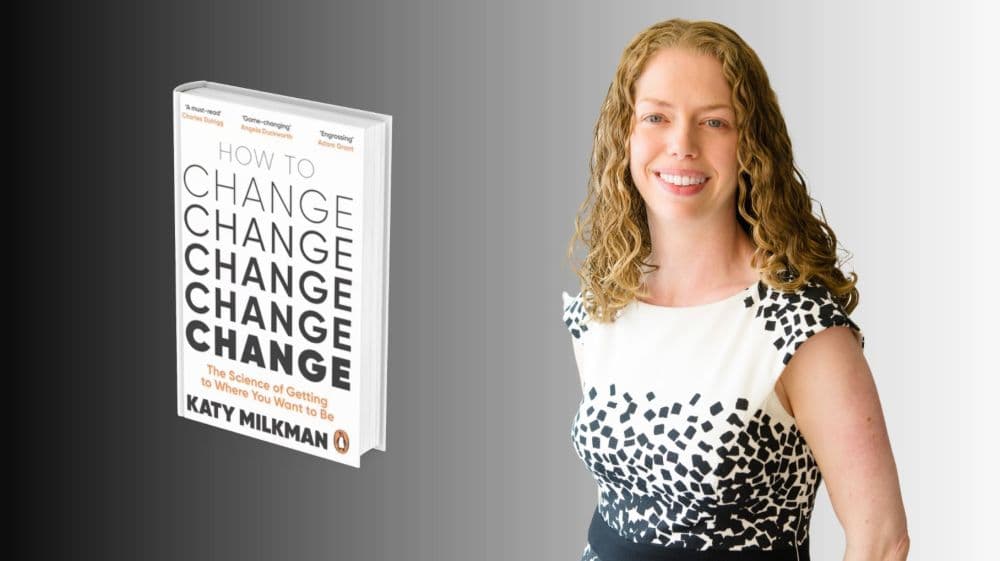
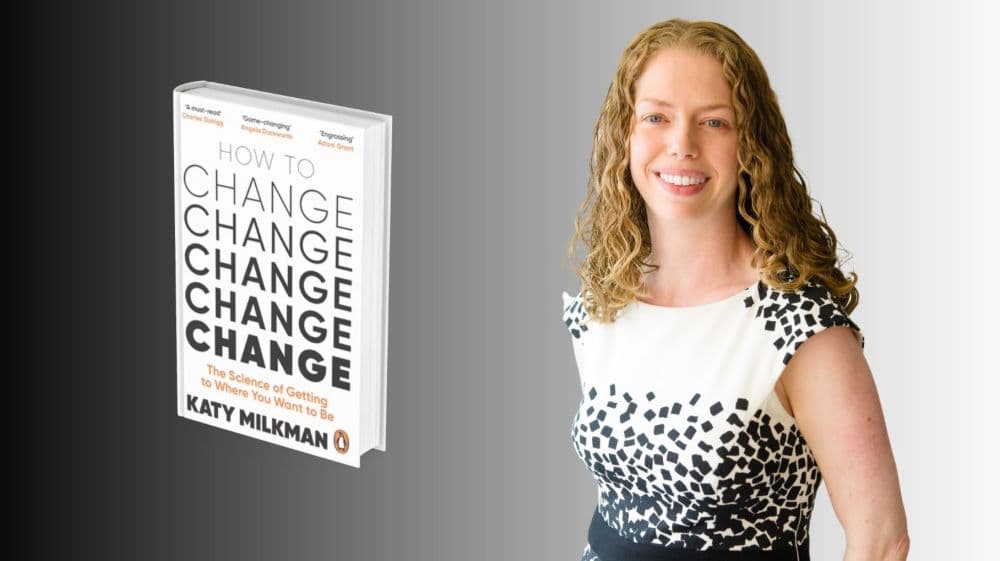
Katy Milkman: How to Change Despite Those Obstacles Inside You
Science-based Ideas to drive change and create a 'new you'
Jump to sectionGetting Started: The Fresh Start EffectKATYS IDEAS FOR ACTIONObstacle #1: ImpulsivityKATYS IDEAS FOR ACTIONObstacle #2: Procrastination
Leadership
People
We all have bad behaviours and stubborn habits. Studies show an estimated 40% of premature deaths are the result of personal behaviours we can change (daily decisions about eating, drinking, exercise, smoking, sex, and vehicle safety).
So to change, we must identify our personal obstacles that are barriers to change. Behavioural scientist and professor Katy Milkman, author of How to Change, told our book club that these obstacles to change are:
-
Impulsivity
-
Procrastination
-
Forgetfulness
-
Laziness
-
Confidence
-
Conformity
Well go through each obstacle and action steps learned in our interview with Katy and her book How to Change: The Science of Getting from Where You Are to Where You Want to Be. But lets start with the new you.
Getting Started: The Fresh Start Effect
A great place to start is harnessing the power of a fresh start. The start of a new life chapter, no matter how small, can give people the impression of a clean slate.
By reminding people of an upcoming fresh start (birthday, start of spring) you can make the same opportunity for behaviour change more appealing. Its the new me- a psychological makeover. People feel distanced from past failures, they feel like a different person a person with reason to be optimistic about the future.
KATYS IDEAS FOR ACTION
-
Look for fresh start opportunities. Is there an upcoming date that could represent a clean break with the past? Birthday/start of season/even just a Monday!
-
A particularly effective time to encourage other people to pursue positive change is after fresh starts.
So, get the timing right, identify your obstacles to change, and use the tools below to break down the barriers.
Obstacle #1: Impulsivity
Present bias is when you favour instant gratification over larger long-term rewards. Its also called impulsivity.
Research shows we are over-confident about how easy it is to be self-disciplined. We think future me will make good choices but too often present me succumbs to temptation.
Even when we flounder again and again, somehow we stay optimistic to do better next time.
KATYS IDEAS FOR ACTION
-
Make it fun. A spoonful of sugar helps the medicine go down sang Mary Poppins, and in the same song In every job that must be done, there is an element of fun. You find the fun, and snap! The jobs a game. Try temptation bundling (audiobooks when exercising) or make work more appealing and the workplace more enticing.
-
Keep it authentic. Gamification only works only if employees buy into the game. It can backfire if players feel the game is being imposed on them.
Obstacle #2: Procrastination
Commitment devices can be something of a godsend. They help us change our behaviour for the better by locking us into choices we make when were clearheaded about whats good for us.
KATYS IDEAS FOR ACTION
Valuable tools include:
-
soft penalties (such as announcing our goals or deadlines publicly, so well be humiliated if we miss them)
-
hard penalties (handing over cash if we fail).
Also, there are:
-
soft restrictions (eating a meal from a smaller plate, using a piggy bank)
-
hard restrictions (putting money into a locked savings account, or listening to juicy podcasts ONLY when at the gym).
Data proves that these tools (hard penalties and restrictions) work well so should be widely popular, but Katy says people often pass on them.
Lots of people are overly optimistic about their ability to overcome their self-control problems through sheer will power.This, and fear of costly failure, are why people arent willing to use them.
Obstacle #3: Forgetfulness
The average adult forgets 3 things each day, ranging from pin numbers to wedding anniversaries. Forgetting is more common the more we attempt to juggle , says Katy. Sometimes I even forget things that are on my calendar.
KATYS IDEAS FOR CHANGE
-
Set timely reminders. Studies show that reminders work FAR, FAR better when we can act on them immediately.
-
Use vivid cues. When we make plans, we dont focus on what will trigger us to act. Use triggers. When_ happens, Ill do_
-
Make a plan (thinking through the where, when, how ) so it works like a pledge. Its a strategy I rely on constantly in my personal and professional life, says Katy.
-
Be choosy about which goals youll focus on , plan carefully to achieve one or two.
-
Consider a checklist. A formal checklist can work wonders (Atul Gawandes book The Checklist Manifesto explains this).
Obstacle #4: Laziness
Humans (and computers) take the path of least resistance to solve problems; its efficient. It can be harnessed to help facilitate change.
KATYS IDEAS FOR CHANGE
-
Add a checkbox. Unless the checkbox is ticked, this action will happen. As people are lazy, the box will often be left unchecked. Research shows setting defaults wisely is a great way to create big wins.
-
Repetition builds habits. Drilling good behaviour (like a firefighter training) until its second nature can help with everything from running a successful business to getting and staying healthy. Positive reinforcement (as seen in James Clears Atomic Habits and Charles Duhiggs The Power of Habit ) makes the action become instinctual.
-
Build in some flexibility. Too much rigidity is the enemy of a good habit.
-
Linking a new behaviour with other habits that already exist makes it easier to follow through during the critical early phase of habit development.
Obstacle #5: Confidence
Too often we assume that the obstacle to change in others is ignorance and so we offer advice to mend that gap. But Katy asks, what if the problem isnt ignorance but confidence and our unsolicited advice isnt making things better but worse?
When someone asks for guidance, we tell them to do what we would find useful. And, after offering that advice to others, we feel hypocritical if we dont try it ourselves. You can use this to prompt change.
KATYS IDEAS FOR CHANGE
-
Be confident in others. Place under-performing employees into mentoring roles could boost their lagging performance.
-
Ask them for their advice. Asking under-performing employees to ****give advice builds confidence and helps them think through strategies for achieving their goals.
-
See yourself as a work in progress. You will fail or miss sometimes. Make explicit allowances for emergencies.
-
Surround yourself with people who will buoy our own beliefs in our potential.
-
Form an advice club. Katys book tells of Carnegie Mellon economist Linda Babcock who started an advice club with four female colleagues to help one another say no more often (to things like low-prestige office tasks). Katy has since set up a similar club. Ive reaped huge benefits from the advice Ive given.
Obstacle #6: Conformity
Research shows its important to be in good company when you hope to achieve big goals, and how harmful it can be to have peers who arent striving to become high achieving impact players. As social learning theory shows, we are often more influenced by observation than by advice.
Many people never wake up to the opportunity to deliberately emulate their peers.
KATYS IDEAS FOR ACTION
-
Copy and paste. Watch peers who achieve a goal and deliberately imitate their methods. The next time youre falling short of a goal, look to high-achieving peers for answers.
-
Use social accountability. Turn social accountability into a commitment device (ie. ask a friend to be your gym buddy).
-
Show trends. If a behaviour is trending upward, tell people about it. An upward trend tells people that this counter-normative behaviour will become the thing everyone is doing.
Postscript: Changing for good
A behaviour change study Katy conducted with psychology professor Angela Duckworth in 2018 for a national gym chain started well in increasing gym attendance, but after the free four-week programme ended, the good results dropped away. What does this teach us?
You need to see achieving transformative behaviour change as more like treating a chronic disease than curing a rash.
The internal obstacles that stand in the way of change such as temptation, forgetfulness, underconfidence, and laziness, are like the symptoms of a chronic disease. They wont just go away when you start treating them. Theyre human nature and require constant vigilance, says Katy. __
So, the message is: It's not "Make the change' it's 'Keep making the change.'
Conversation starter questions
-
Is there a fresh start opportunity coming up that we can use to prompt others to change?
-
Thinking of a stubborn problem, what is the obstacle stopping us from changing in this instance?
-
What are two action steps well try to solve this problem?
-
Can we commit to this new behaviour in the long-term?
About Katy Milkman
Katy Milkman, PhD, is author of How to Change and an award-winning behavioural scientist and professor at the Wharton School of the University of Pennsylvania. Shes worked with dozens of organisations to encourage positive change including Google, Walmart, the US Department of Defense and the American Red Cross.
If you'd like to increase your professional and personal development why not consider signing up your teams as Leadership Pass holders with Growth Faculty? Choose the plan that suits you , and see who's up next .
Upcoming Learning
Who's Up Next?We're continually sourcing the world's greatest minds for your business success, so subscribe today for event updates, business ideas, leadership tips and tools for growth.
Related Articles