Inclusion & belonging in the workplace
The benefits of creating a sense of belonging at work


People
"True belonging doesn't require you to change who you are, it requires you to be who you are." - Dr Brené Brown
If we feel we don't belong at work, we search for the exit.
Within 3 months, 52% of surveyed new hires said they were already actively trying to leave their company.
Top reasons given by Gen Z and Millennials included the lack of any sense of belonging and whether the company cared about their wellbeing. (1)
Creating a sense of belonging in the workplace is good for retention, engagement, productivity, creativity, and happiness. Its easy to see why inclusion and belonging are important, so we thought we'd explore best practice.
4 Ways to Foster Belonging in the Workplace
"We are worthy of love and belonging right now. This minute. As is." - Dr Brené Brown
Feeling like you matter, feeling like you belong, feeling safe. It's not much to ask of a workplace, is it? And yet the Great Resignation, the rise of quiet quitting, and record levels of burnout and other mental health and wellbeing issues suggest inclusion and belonging in the workplace is not universal.
More than ever, employees constantly self-reflect on questions like:
- Am I happy?
- Do I feel fulfilled at work?
- Am I satisfied where I am?
To this end, leaders must lean more towards modern leadership styles and behaviours like recognising employees better and building stronger connections within teams.
Utilise Modern Leadership Styles
Research by Korn Ferry Hay Group shows an up to 30% increase in business performance can be directly attributable to the climate that leaders create through their style of leadership.
Dr Kirstin Ferguson, author of Head & Heart: The Art of Modern Leadership says a self-aware modern leader will seek to encourage a sense of flourishing for those they work with.
Conversely, the style of leadership described by Dr Brené Brown, author of Daring Greatly and Dare to Lead, of promoting a "fitting in" culture results in a missed opportunity to help people find their personal drive.
In a nutshell, the modern leader knows the value of fostering belonging at work and focuses on each employees individual strengths, perhaps with a tool like the 6 Types of Working Genius from organisational culture expert Patrick Lencioni.
Recognise & Reward Employees at All Levels
One simple way to create a sense of belonging in the workplace is through reward and recognition.
Celebrating and rewarding the little moments is what keeps cultures fresh and evolving, says Culture Fix author Colin Ellis.
He says vibrant cultures use recognition and rewards for the efforts of their people to motivate them and inspire others . The key is fairness.
"Every culture needs to give equal recognition to the efforts of all." - Colin Ellis
It's not expensive. Recognition can be as simple as noticing. Rewards can be as inexpensive as showing gratitude , saying thank you , and praising good work.
Build connection
Remote and hybrid workplaces shake our sense of belonging at work.
According to Mind Share Partners almost 42% of employees have experienced deteriorating mental health since remote work became the norm in 2020. (2)
Takako Hirato in The Virtual Leader suggests bringing rituals online that create a sense of belonging and putting policies in place such as:
- Create open video working spaces where employees can see and work together, sometimes on different tasks, and interact casually with one another when they take breaks.
- Conduct daily stand up meetings. Each team member talks about what they're working on, current progress, and where they are stuck, and what work they have on in the coming days.
"All it takes is being more sensitive towards the goals, desires and problems of your employees." - Takako Hirato
Build a Psychologically Safe Workplace
So keen to belong are humans that our brains neural processors can hardly differentiate between social pain caused by ostracism and physical pain. (3)
As a result, we fear anything that might cause people to reject us. A psychologically safe workplace continually signals to workers: You belong, You matter, You're safe.
Kylie Lewis says some things you can do include:
De-stigmatise failure - set expectations about failure. Admit to your own mistakes.
Express appreciation - listen, acknowledge and thank.
Encourage people to ask for help - make it easy to do so.
Make risk-taking the norm - talk about what you're trying or learning.
Ask yourself, how safe is it in your business for employees to tell leaders what they don't want to hear?
What is the Value of Fostering Belonging in the Workplace?
Gartner says inclusion corresponds with greater on-the-job effort and intent to stay , as well as high employee performance.
Belonging is a key component of inclusion. When employees are truly included, they perceive that the organisation cares for them as individuals, their authentic selves, says Ania Krasniewska, Group Vice President at Gartner.
Here are some of the ways belonging and inclusion help your business.
A Sense Of Belonging Is Good For Your Bottom Line
Deloitte's Designing the Workforce Experience report shows belonging can lead to:
- a 56% increase in job performance
- a 50% reduction in turnover risk
- a 167% increase in employer net promoter score
- 2X more employee raises
- 18X more employee promotions
- a 75% decrease in sick days. (4)
There's a clear correlation between belongingness in the workplace and performance.
Employees Want to Show Up
People gravitate to where they feel belonging.
As Kirstin Ferguson says in her book Head & Heart the new hybrid office needs to be a cultural touchstone where people reconnect and are reinvigorated.
"If you want people to come into your workspace, what kind of feeling are you hoping they are being injected with by the time they leave?" she asks.
Designing spaces for collaboration help build and reinforce relationships and a sense of belonging.
Reduced Quiet Quitting
When people feel included and a sense of belonging, they are less likely to engage in quiet quitting.
Quiet quitting is when employees show up to work, fulfil their primary responsibilities and go home. No stepping up. No raising their hand. No going above and beyond.
If employees don't feel the support of their team or manager, they won't want to push themselves.
Increased creativity
A 2020 study found significant effects of workplace belongingness on innovations in the IT industry.
"These positive effects show the effects of employees' sense of belonging on the act of creativity," the study's authors wrote. The reason may be due to social interaction in the workplace, organisational climate, positive effects of the organisation in career development, and leader-employee interaction.
People can be their true selves
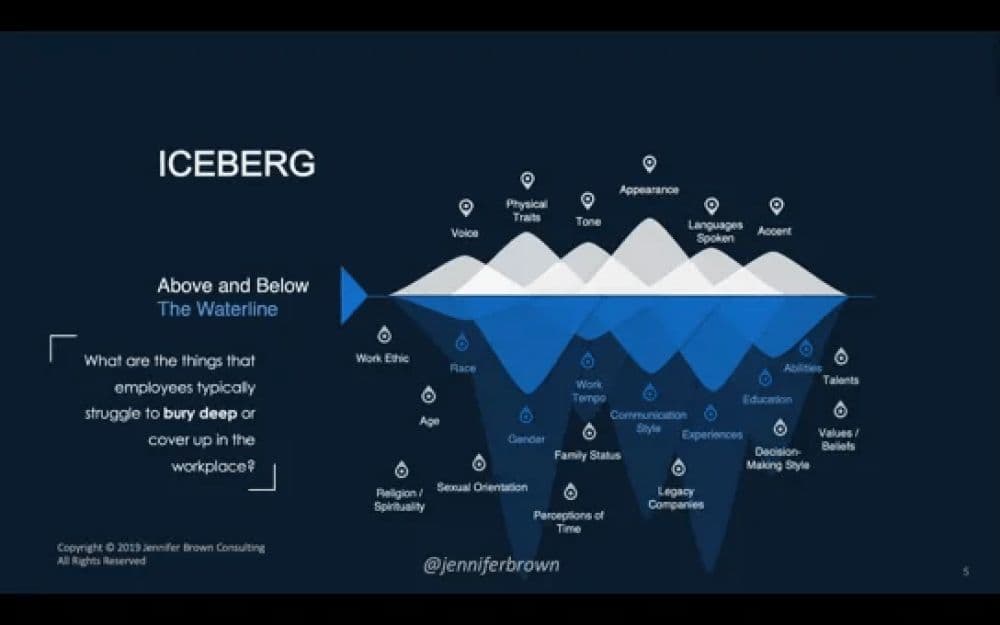
At one of our IWD events, New York based inclusivity expert Jennifer Brown shared an eye-opening illustration of an iceberg (below) to show how employees cover up aspects of themselves in the workplace, such as gender and race traits, and sexual orientation.
The LGBTQI entrepreneur and author of Inclusion, How to Be an Inclusive Leader and Beyond Diversity says covering or playing down your identity to manage others reactions is exhausting.
Women and other minorities hide traits 'below the waterline' all the time, she says. It's hurtful, it's unfair, and it's damaging for businesses.
Help Build a Sense of Belonging In Your Workplace With Growth Faculty
Belonging is a real human need, and a vital part of a healthy workplace culture.
One way to ensure your team is up-to-speed on the latest research and teachings on belonging and inclusion is with Growth Faculty.
Whether you're responsible for leadership development for a team of five or a division of five hundred, Growth Faculty's upcoming virtual masterclass program offers all this and more. It's nirvana for leaders and leadership development (L&D) professionals.
Note: All Growth Faculty virtual masterclasses are available to members as part of an annual membership. Enterprise packages available.
Download our 2026 program or scroll down for a quick overview of what's on.
References:
1. Caroline Colvin, 2022, New Hires Job Searching Within First 6 Months, Study Says , HR Dive website.
2. Statistic taken from Takako Hirato's book The Virtual Leader
3. Eisenberger, Lieberman, & Williams, 2003, from Australian Psychological Society In Psych 2019 , Vol. 41, June Issue 3.
4. Colleen Bordeaux and Stephanie Lewis, 2021, Designing the workforce experience with the human at the centre , Deloitte.
Upcoming Learning
Who's Up Next?We're continually sourcing the world's greatest minds for your business success, so subscribe today for event updates, business ideas, leadership tips and tools for growth.
Related Articles